Monday, October 19, 2020

COMMON ANCIENT INSTRUMENTS

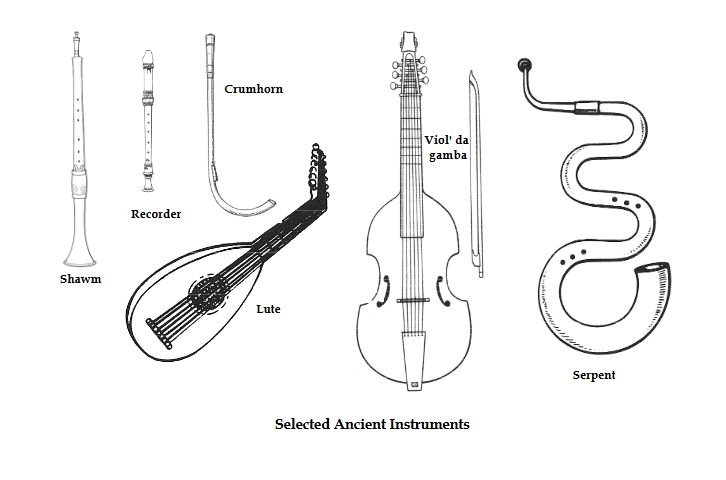
 The VIOL Family(Ancestors to the modern violin family): These bowed instruments come in a variety of sizes, and they have a lighter sound than that of the modern violins

The LUTE Family (Ancestors to the modern guitar family): The lute is a pear-shaped guitar-like instrument with a rounded back and a short, wide fingerboard. The lute, and its larger relative the chitarrone (Bass-lute) were the most sophisticated polyphonic string instruments of the Renaissance.

Ancient WIND instruments(ancestors to the modern woodwind family). Recorders (the preferred wind instruments of the Renaissance period) are various-sized wooden instruments that play much like a flute, but are softer in sound. The shawm, the crumhorn, and the racket are raucous-sounding reed-instruments that are ancestors to the modern oboe and bassoon

Ancient BRASS instruments(ancestors to the modern Brass family). Sackbuts are trombone-like instruments of various sizes used in the Medieval, Renaissance and Baroque eras. The cornetto and the serpent are trumpet-like wooden and leather instruments that use finger holes instead of valves to produce their pitches. The natural horn is a valveless brass instrument that evolved into the modern "French horn.


The PIANO

 The piano, the most prominent of all keyboard instruments, is actually a percussion instrument, because it employs an intricate key-mechanism that engages a felt-tipped hammer to attack the string. The piano can produce a variety of dynamic contrasts and tone colors, depending on how hard/fast the keys are depressed by the player. The original piano prototype was called a "Fortepiano," because it was capable of playing both loud and quiet (unlike a harpsichord which has no dynamic variance.)


ELECTRIC andELECTRONIC Instruments

ariousELECTRIC instruments (such as electric guitars, keyboards and amplifiers) have risen to prominence in the late 20th century, primarily due to developments in popular music. ELECTRIC instruments, however, should not be confused with ELECTRONIC instrumentstrue synthesizers that rely on digital and/or microchip computer technology. Synthesized instruments can simulate traditional musical sounds as well as create sounds that are completely original. Many synthesized keyboards, guitars, drum machines and wind instruments can communicate with computers through a technology known as MIDI ("Musical Instrument Digital Interface"). Synthesizers and the more traditional "Electric" keyboards and guitars have added new dimensions of color to modern music.


The PERCUSSION family

 The percussion family is comprised of instruments that must be struck by an object (usually a mallet, a stick, or a hammer) in order to produce a musical sound. Composers have made greater use of percussion color in their scores since the 1880s. Percussion instruments fall into two types (pitched and non-pitched)

PITCHED Percussion (can play specific notes):

timpani (various-sized kettle drums) 

 piano and harpsichord (an internal object hits the strings)  

orchestra bells ("chimes"), glockenspiel (a rack of metal bars), and handbells 

xylophone (an arranged series of various-sized metal bars)

 marimba (an arranged series of various-sized wooden bars) 

 vibraphone ("vibes"an electric "xylophone" with windpipes) 

NON-PITCHED Percussion(no distinct pitch is created):

bass drum 

snare drum 

castanets 

cymbals 

triangle 

tambourine 

 • gong (a large, suspended "Chinese" cymbal)   

Both pitched and non-pitched percussion instruments can be classified by range, for example:Triangle/Glockenspiel (soprano), Snare Drum (alto), Timpani (tenor), Bass Drum (bass)


The BRASS family

 The brass family is comprised of powerful metallic instruments that must be blown into by theplayer to make a musical sound.The tone-color (timbre) of most brass instruments can be altered by the use of various types of mutes which are inserted into the large end of theinstrument. Until the invention of the VALVE, brass instruments could only produce a limited number of pitches, which lessened their usefulness to composers. Instrument builders experimented with various VALVES that would avail more pitch varieties to these instruments. Many modern brass instruments have a system of 3 VALVES that can be depressed in variouscombinations to produce different pitches. The modern "rotary" valve was invented in the early Romantic period (c. 1830)an invention that made the brass family more responsive and reliable. As a result, Romantic composers made greater use of the brass family.

The most common types of brass instruments include

:• various-sized trumpets (use valves to change pitch)  

• various-sized trombones (use a slide instead of valves to change pitch) 

 • the "French Horn" (use valves to change pitch)  

• the Tubaa very low brass instrument (uses valves to change pitch)

The standard range categorization of this family is as follows


:Trumpet (soprano),Alto Trombone (alto),Tenor Trombone and upper French Horn(tenor), Bass Trombone and low French Horn (bass)